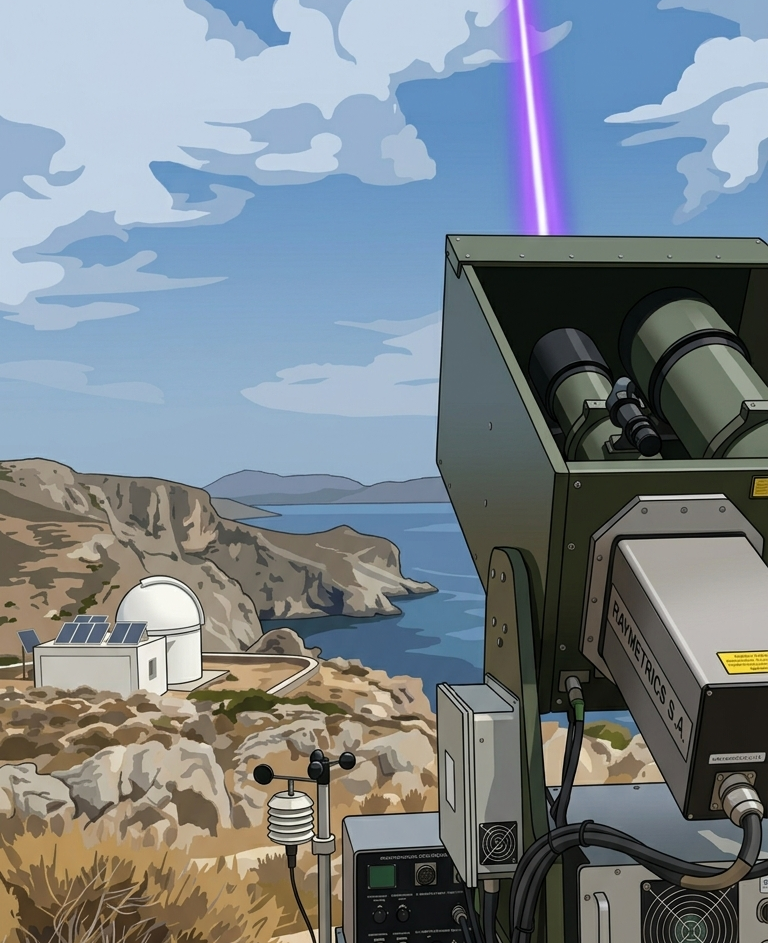
Developed by the National Observatory of Athens (NOA) and Raymetrics S.A., the High Power UV Lidar will be installed at the PANhellenic GEophysical observatory of Antikythera (PANGEA). It features a high-power polarized laser (355nm), two telescopes for near and far-field measurements, and is optimized for day and night operation. The lidar will measure temperature, water vapor, and aerosol properties, including extinction coefficients, backscatter, and depolarization ratios, with high spatio-temporal resolution. It will also include a multispectral detector for fluorescence spectra and Raman scattering measurements, targeting gases like O₂ and CH₄, and detecting biogenic particles such as pollen, viruses, and bacteria.
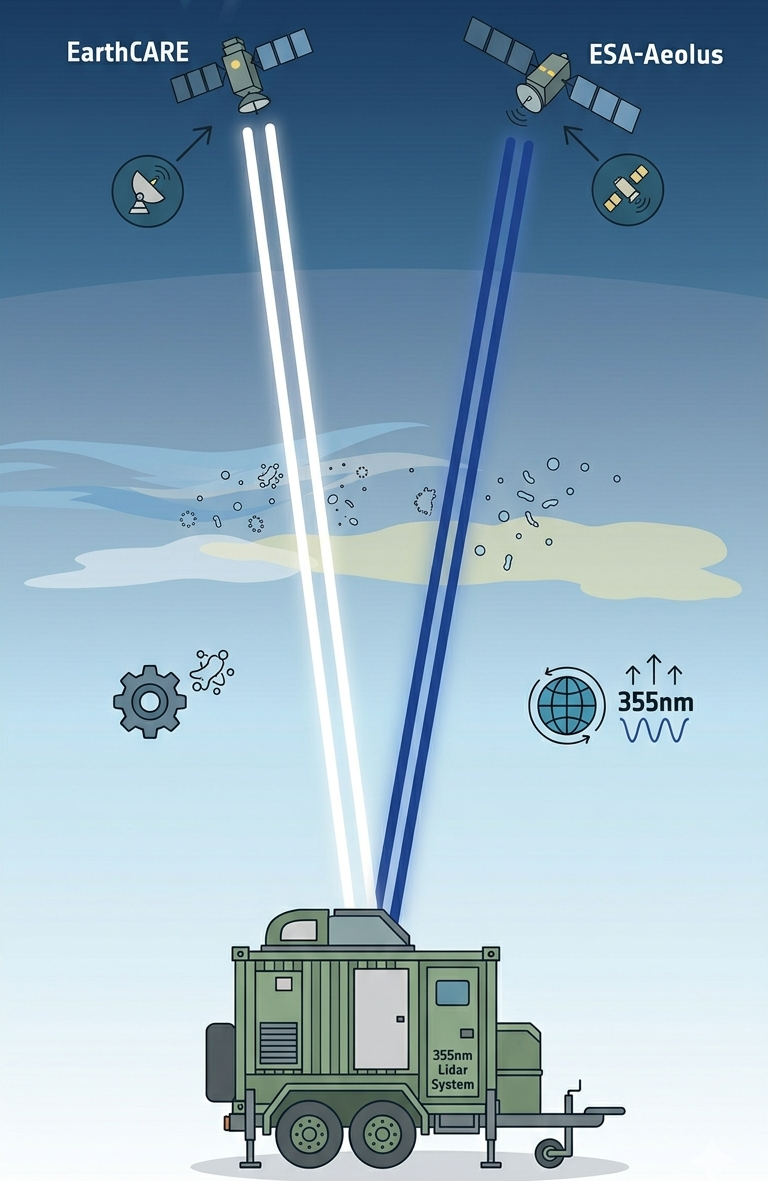
EVE, a depolarization lidar system by Raymetrics S.A., NOA, and LMU Munich, supports the ESA-Aeolus mission with mobile, high-precision aerosol measurements. Operating at 355nm, it uses dual lasers and polarization-sensitive detectors to provide reference measurements. Upgradable to multi-wavelength capability, EVE also supports EarthCARE satellite calibration. It will be deployed in the ASKOS campaign, with publications on its initial tests underway.
ASSA, based on Siomos et al. (2020, 2021), uses multi-spectral Raman lidar data to separate aerosol species by simulating backscatter and depolarization profiles from aerosol mixtures in the OPAC database. It matches measured lidar and radiometric data to determine the best aerosol mixture. This flexible approach supports systems operating in UV/VIS/IR and incorporates hygroscopic growth effects.