MISSION
A strategic goal of NOA to establish a sustainable climate observatory at the island of Antikythera (35.861N, 23.310E, 110m a.s.l). The site has been selected by NOA and PANACEA due to its representativeness of the broader region of Eastern Mediterranean.

DUST

SMOKE

AIR POLLUTION

SEA SALT
IMPLEMENTATION & STANDARDS
NOA and ReACT Group are currently implementing the PANGEA-ReACT facility at Antikythera
The facility will fulfill the optimum requirements of the ACTRIS RI
Multi-wavelength lidar for the 24/7 monitoring of the atmospheric state. The system enables the determination of the particle backscatter coefficient at 355, 532, and 1064 nm and of the extinction coefficient at 355 and 532 nm, allowing aerosol classification and microphysical characterization to derive the particle size distribution and concentration. In addition, the system operates two polarization-sensitive channels at 355 and 532 nm, to determine the aerosol particle shape from the (particle) linear depolarization ratio, to separate dust and non-dust particles in mixed aerosol layers, and to investigate mixed-phase clouds.
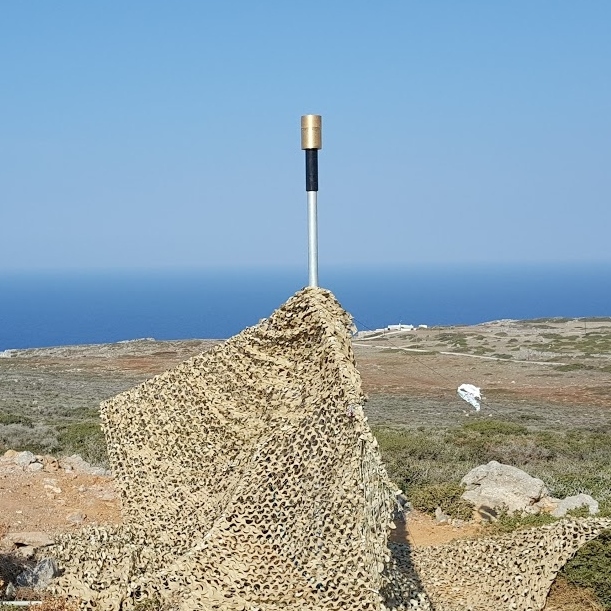
A compact and robust instrument for continuous long term measurements of the ambient electric field, adverse environmental conditions. It is particularly suitable for continuous monitoring of atmospheric electric field conditions, associated with varying weather conditions and electric content, such as during thunderstorms or extreme volcanic activity. The output signal is proportionate to the electric field strength and currently operates at a range of 2kV/m with a precision better than 1%. The instrument is mounted on a 3m mast in order to avoid ground distortions. The FM is ideal for remote site installation due to its low power consumption and straightforward data collection system.
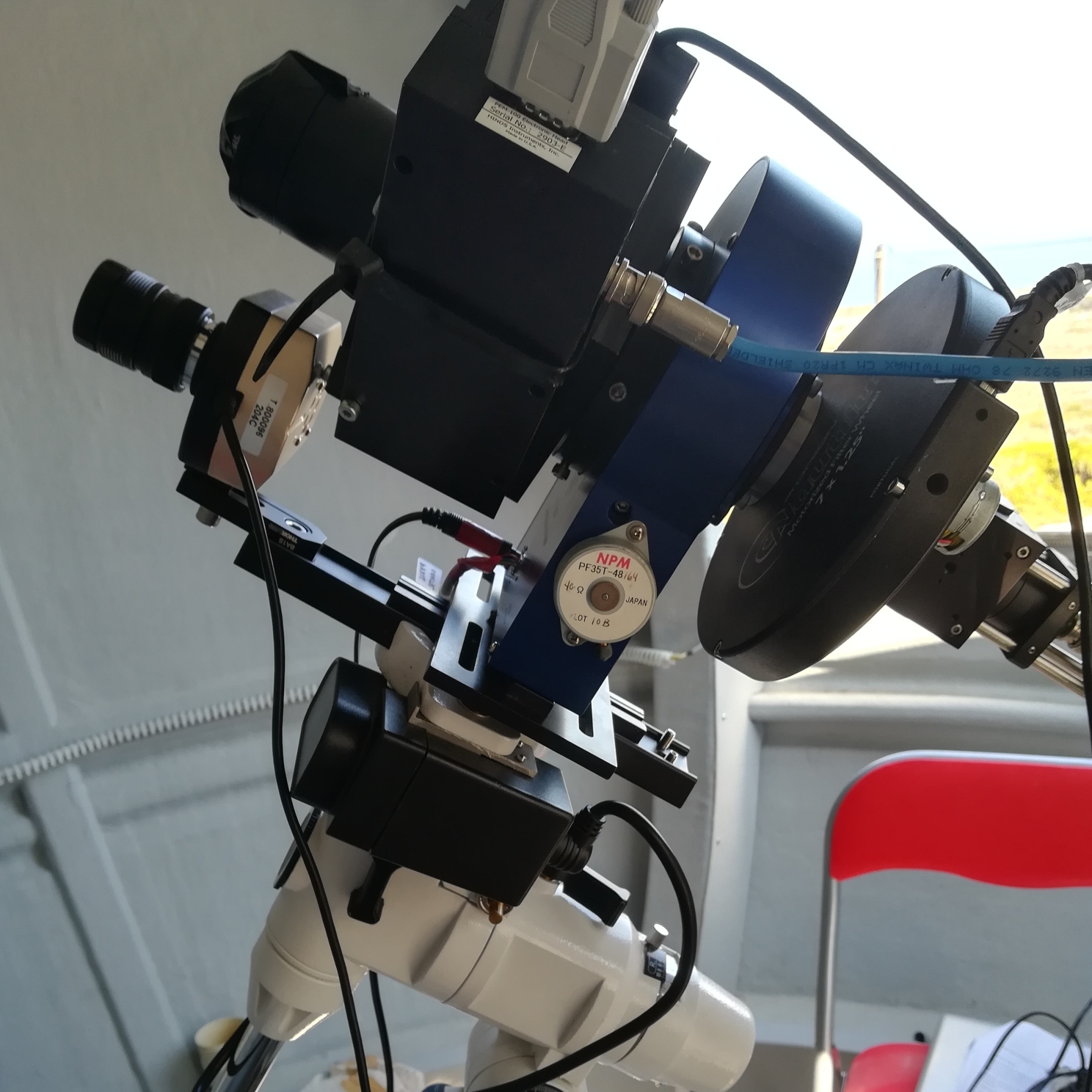
A prototype solar polarimeter, kindly conferred by the University of Hertfordshire, is designed to operate with direct sun tracking capabilities and measures the degree of linearly and/or circularly polarized sunlight due to forward scattering from atmospheric aerosols. Measurements are centered on 550nm, due to light detector current limitations, while the instrument’s precision and accuracy are of order of the 1ppm and 1%, respectively. SolPol is a robust instrument capable of manual operation per demand, especially under heavy Saharan dust loads and with low maintenance requirements. It is hosted within a medium sized astronomical dome for the optimum protection-to-applicability relation.